
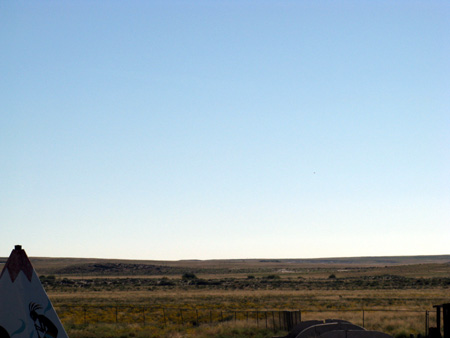
The terror I felt last night was mostly for naught – perhaps just a way of ensuring that I don’t get too uppity. However, the entrance to the Park was as intimidating this morning as it was last evening – or perhaps more so in the blank light of day, with the inevitable commercial nonsense just outside the gates (see that fake teepee to the left and imagine the 75 mile per hour spring winds that the local indigenous peoples lived with) .
We drove from the south end of the Park to the north section – the Petrified Forest National Park is a long, narrow strip of land inside the larger geographical region called the Painted Desert. The advent of the railroad in the late 1800’s brought in tourists and made materials that had lain untouched for hundreds of years ripe pickings for entrepreneurs and rock hounds, who carted it away by the wagon loads. The petrified wood of the area had been so vandalized by tourists and commercial enterprises that by 1906 Teddy Roosevelt made it into a National Park in an attempt to protect the materials.
Even today, rangers check vehicles carefully for purloined rocks and in controlled studies have found that signs and warnings are insufficient to keep people from carrying away the beautiful minerals.
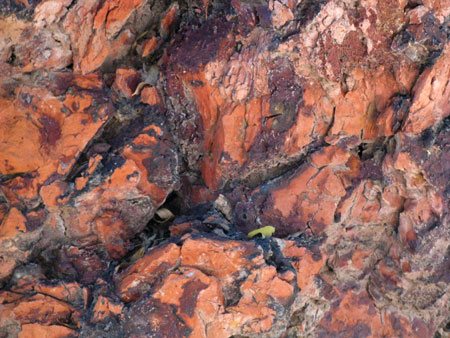
The southern part of the Park is where most of the petrified wood is found. Some alterations done by earlier Park employees are inadvertently informative. The formation called the “Agate Bridge”, a large petrified log that spanned a gully, was reinforced with concrete supports because it was bound to fall as the rocks that held it up weathered. However, the Park Service notes on its signage that even the supports that well-meaning earlier rangers had installed would meet their demise over time. Time alters all.
Speaking of which – other kinds of changes have occurred within the park over time; near the Puerco River (and Interstate 40 and the BNSF Railroad) are the remains of the Puerco Pueblo, with its peak habitation in the 13th and 14th centuries. And from the overlook at the Pueblo one can see the cell phone towers, the highest vertical elements around.
In the living area for employees, Richard Neutra, a well-known architect of the 1950’s and 60’s, thought he was imitating the pueblo styles of the Indian ruins he saw around the region, but in truth, he did what he did best – designed in the style known as high modernism, with flat roofs, plain exteriors, windows flush to the walls, and sunk unobtrusively into the landscape.
Nothing of his modernism clashes with the spare pueblo style, although nothing Neutra designed is as beautiful as the walls that remain from the Old Ones, the peoples who lived here and near here in around 1200 –1300. Their dwellings had the advantage of using the gorgeous local stones, which fracture in specific ways, and at least in some of the remains, it’s clear that the builders embedded different colored stones to enhance the beauty of the edifice.
On our initial drive through the entire park, stopping at some but not all of the overlooks, we arrived at the main visitor center, in the northern section, just off I-40. We obtained a key to our apartment (all mod cons), unpacked, made up our beds, and after a light lunch at the restaurant on the premises, Jer went back to Holbrook (25 miles to the west) to buy grocs.
He returned at 4 PM and by about 6 PM I had decided I needed to go painting – I was getting obsessed with not wasting time, and more specifically, not spending another night worrying about whether I could paint this landscape. So off we went, to Tiponi Point, located about 1/8 mile up the road. Already the sun was setting (Arizona doesn’t observe daylight savings time), and before I got my things out, the sun had disappeared, although some of the higher points of the red hills were still glowing. I stared hard, squeezed out paint rapidly, remembered to take a quick photo, and finished the fastest painting I’ve ever done – I think I painted about 10 minutes, altogether. It was exciting and fun and frustrating. It was a good beginning.
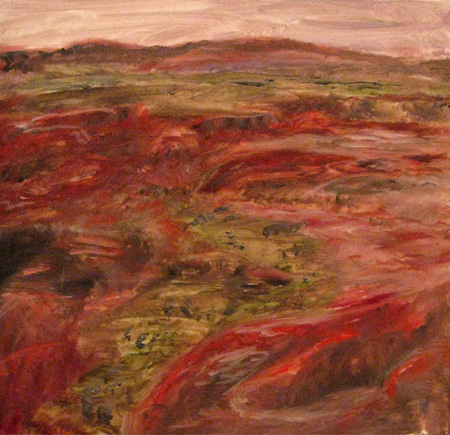
Tiponi Point, September Dusk. (Petrified National Forest) ,12″ x 12″, Oil on masonite, 2010
Normally I would have far more photos in an introductory travelogue like I’ve just given. I would also add links for more information about factual items. However, the hinky nature of the internet here at the Park means uploading photos is an iffy process and getting to web sites equally difficult. Just getting onto the internet is arduous.
And of course, the problem of value and hue in the web-processed painting is problematic because I’m using a laptop, where those elements are highly dependent upon the angle of the screen. So unless/ until we find the optimal place to do the blogs, I will probably be writing more text than showing photos. I am saving other photos, hoping to complete the posts at a later date.
Reported from Apt K, Petrified Forest National Park, uploaded Monday September 27, 2010. –June
 juneunderwood.com
6 responses to “Petrified Forest Residency: Day 1, September 26, 2010”
Wow June from the beginning photo, it reminds me of home (NE Montana) will definitely need to come see it for myself. And give up worrying about the night fears…they will just get in the way of the work. I know, I know, easier said than done. Do I need to Fed Ex a copy of “Art and Fear”?
Did you get a stat on the current pilfering of petrified wood? I seem to remember the ranger saying something like a ton is carted off EVERY MONTH. My dad did it in 1955 when we were there. Check out the display of letters of apology (with returned wood enclosed) in the visitors center. Whatever the figure was, my jaw bounced off the pavement.
Beautiful colors, June.
Hope you brought plenty of that orange paint. Looks like you’re going to need it! Love it love it love it…
Early morning or late afternoon are best for the colors in that area. However if you are lucky enough to be there when it rains grab your paints and run outside; the colors are at their best when wet.
I know you would like to be there for more than two weeks, and I agree with you. Still your time frame may force you to do less thining and more painting by pure gut. The results could be very interesting.
Oddly enough, morning and evening light isn’t necessarily the best time for color here — a fact I learned at approximately 6:30 AM this morning (and again at 10, when I saw the same geologic structures in a different light. I will blog on the phenomenon when the Park server allows it.